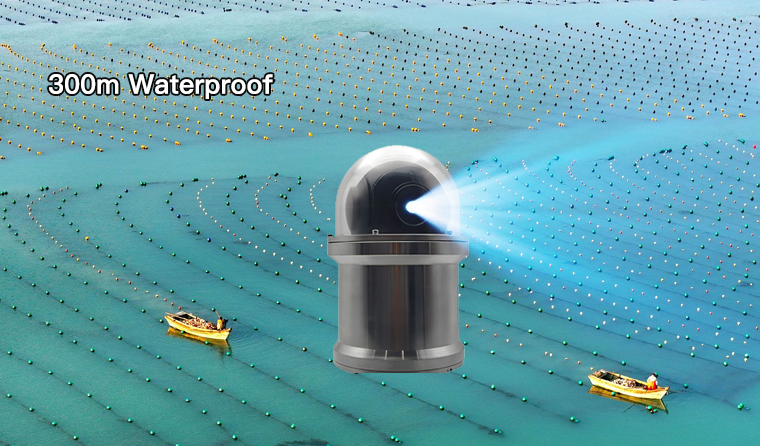
I. Overview
Underwater aquaculture cameras are one of the core equipment for intelligent management of aquaculture. Their waterproof performance directly determines the service life of the equipment, operational stability, and reliability of monitoring data. In complex underwater environments, cameras need to withstand multiple challenges such as water pressure and water corrosion (e.g., changes in salinity and pH). Therefore, the waterproof rating has become a key indicator to measure the quality of such equipment. This article will detail the common waterproof rating standards for underwater aquaculture cameras, the application scenarios corresponding to different ratings, and core waterproof technologies.
II. Core Waterproof Rating Standard: IP Protection Rating System
Currently, the waterproof rating of underwater aquaculture cameras generally follows the internationally accepted IP (Ingress Protection) rating standard. The standard consists of two digits: the first digit indicates the dustproof rating, and the second digit indicates the waterproof rating. The higher the digit, the stronger the corresponding protection capability. For underwater aquaculture scenarios, the focus is on the second digit (waterproof rating). The common core rating range is IP65 to IP69K, and some deep-water equipment will be marked with additional water pressure ratings (e.g., 10 meters underwater, 30 meters underwater, etc.).
Supplementary Note: In the IP rating, a first digit of 6 indicates complete dustproofing (no dust ingress), which is the basic dustproof requirement for underwater aquaculture cameras. Therefore, mainstream equipment all have an IP6X dustproof rating, and the following will focus on the waterproof rating (the second digit).
III. Common Waterproof Ratings and Application Scenarios of Underwater Aquaculture Cameras
1. IP65 Waterproof Rating
Waterproof Capability: Can resist low-pressure jet water flow from any direction (e.g., rainwater, slight splashes), with no harmful water ingress.
Application Scenarios: Suitable for edge monitoring of shallow water areas in aquaculture environments, monitoring above seedling ponds (non-submersible), indoor aquaculture workshops, and other scenarios with no direct submersion requirements. In such scenarios, water fluctuations are small, and the equipment does not need to be in long-term contact with water, only needing to prevent water splashing or water flow impact during cleaning.
2. IP67 Waterproof Rating
Waterproof Capability: Can be immersed in 1 meter of water for 30 minutes under specified pressure, with no harmful water ingress.
Application Scenarios: Suitable for submersible monitoring in shallow water areas, such as shallow water areas (water depth ≤ 1 meter) of ponds and paddy field aquaculture, and monitoring in fish and shrimp seedling ponds. This level of equipment can be temporarily immersed in water, and can cope with daily water fluctuations and short-term water level rises in aquaculture, but is not suitable for long-term deep-water work.
3. IP68 Waterproof Rating
Waterproof Capability: Can be long-term immersed in water at a specified depth exceeding 1 meter. The specific waterproof depth and immersion time are specified by the manufacturer (e.g., 10 meters, 20 meters, 30 meters underwater, etc., and the immersion time is usually in a continuous working state). This is the mainstream rating for underwater aquaculture cameras, with the core advantage of stable deep-water sealing performance.
Application Scenarios: Covers most large-scale aquaculture scenarios, including deep-water pond aquaculture, cage aquaculture (offshore, freshwater), and deep-water aquaculture ponds in industrial recirculating aquaculture. For example, in the aquaculture of benthic aquatic products such as sea cucumbers and abalones, IP68-level (10-20 meters underwater) cameras can go deep into the bottom to monitor growth status; in cage aquaculture, they can be long-term immersed in water to monitor fish school activities, feed residues, and other situations.

4. IP69K Waterproof Rating
Waterproof Capability: Can resist high-temperature and high-pressure strong jet water flow (e.g., 80℃ high temperature, 80-100bar pressure water flow), and also has the deep-water waterproof performance of IP68 level. This level is additionally suitable for high-temperature and high-pressure cleaning scenarios, with stronger waterproof sealing performance.
Application Scenarios: Suitable for aquaculture scenarios with high requirements for equipment cleaning, such as industrial high-density aquaculture workshops (needing regular cleaning of biological fouling and feed residues on the equipment surface with high-temperature and high-pressure water flow), and offshore high-salinity aquaculture environments (high-salinity water is easy to corrode seals, requiring a higher protection level).
IV. Core Waterproof Technologies of Underwater Aquaculture Cameras
1. Sealing Structure Design: Adopts multiple sealing rings (e.g., silicone rings, fluororubber rings) for sealing, focusing on protecting key parts such as lenses, interfaces, and body joints. Some high-end equipment adopts an integrally formed body to reduce the risk of water leakage at the joints.
2. Pressure Balance Technology: Deep-water equipment will have a built-in pressure balance device (e.g., pressure compensation film), which can automatically adjust the pressure inside and outside the body to avoid deformation and water leakage of the sealing structure due to excessive water pressure.
3. Corrosion-Resistant Materials: The body is made of corrosion-resistant materials such as stainless steel and engineering plastics (e.g., ABS, PC), and the lens is made of anti-fog and anti-corrosion optical glass, which is suitable for high-salinity and high-acidity-alkalinity aquaculture water environments.
4. Interface Protection: Uses waterproof connectors (e.g., aviation plugs, waterproof USB connectors), and fills the interface with sealant to prevent water from seeping into the body through the interface and damaging electronic components.
V. Purchase Suggestions
1. Choose the Rating on Demand: Select the corresponding waterproof rating according to the aquaculture water depth, water environment (salinity, pH), cleaning requirements, etc. For example, IP67 can be selected for short-term submersion in shallow water areas, IP68 (with clearly marked waterproof depth) is required for long-term work in deep water areas, and IP69K can be selected for industrial aquaculture that requires high-temperature and high-pressure cleaning.
2. Pay Attention to Certification Qualifications: Choose products with formal IP rating certification to avoid purchasing equipment with falsely marked waterproof ratings.
3. Consider Other Performances: In addition to the waterproof rating, also pay attention to the camera's night vision capability, clarity, anti-interference performance, etc., to ensure it meets the actual needs of aquaculture monitoring.